Showing posts with label utah. Show all posts
Showing posts with label utah. Show all posts
Wednesday, May 12, 2010

Sunday, May 9, 2010
Utah - May 9, 2010

Our Campsite in Utah (Scofield State Park)
Just as the sun was beginning to peak around the horizon, I woke up shivering. The sides of the tent were wet and the damp cold had seeped through the sleeping bag.
“I’m so cold,” I said, not particularly caring if Mateo was awake to hear me, or if I’d wake him up with my complaining.
“Me too,” he replied, as if he had been awake just as long as I had, shivering and thinking about the dampness like me.
“I think I have enough room in my sleeping bag for the both of us,” I suggest. And, without hesitation Mateo attempted to climb into my sleeping bag.
I have to tell you at this point that this is a laughable thing for me to have suggested. We’re both overweight, and even two trim adults would have a hard time sharing a sleeping bag meant for one. But we somehow managed to squeeze into one sleeping bag without tearing it at the seems. The body heat instantly put me back to sleep.
When I woke up an hour later, it was because my body could no longer stand to sleep rigidly straight trapped in a skin tight bag. At this point, I didn’t care if it meant I had to get up and make the coffee in the morning cold, I had to get out of the sleeping bag (or force him out of it). So I squeezed out, sat up in the tent and soaked my sleeve on the side of tent in the process. I promptly jumped into the car and blasted the heater. It took roughly half an hour and several slow laps of driving around the RV camp for the engine to warm up enough to heat the car properly. By then Mateo had made a warm nest of three sleeping bags all to himself in the tent, and he fell back asleep for another hour. I was now wide awake and couldn’t go back to sleep, so I made coffee on the propane stove and took a shower in the bathroom meant for RV campers.
Bathing in public showers is always an adventure. First you have to find a place to put everything: your toiletries for use during the shower, the toiletries for use just after the shower, your dirty clothes, your clean clothes, your towel, AND your shoes and socks.
Then you have to make sure the door is securely shut. Usually there is some trick to lining up the lock with the latch, lifting the door slightly, or just hanging a portion of your shoe or other personal item over or under a door to indicate “occupied.”
Then you have to figure out how the shower works, which way to turn the knob for hot water, and how to avoid the stream of water until it has reached the proper temperature.
In the end I had to put all of my belongings in the spiderweb infested window sill because it turned out to be the only dry spot in the shower compartment once you have the water running for any length of time. I swear this water went uphill to soak my socks. I guess that’s the nature of showering in these kinds of places.
And let me ask you something… do you use those shower benches? I mean, other than to hold your shampoo bottle or to use to balance for washing your feet, do you actually sit your naked butt on a bench in the shower? This seems just plain wrong to me. Like the sensation of peeing with your clothes on… something your body/mind won’t let you do without some serious convincing. Especially as a female I think sitting on a wet bench is unnerving. That being said….. I do not squat over toilet seats. If the toilet seat is dry, I sit on it. I learned, from the AIDs awareness campaigns in the early 90s, that toilet seats are actually inhospitable environments for things like AIDs and such, so I go ahead and sit in peace when I pee. But sit on a bench with my bare butt?! No way!
-CB
Saturday, May 8, 2010
Native American Drawings
If you follow the "shortest highway in America" through Thompson Springs town and onto a dirt road, you will eventually reach a parking lot amongst sage brush and red rock cliffs. Get out, use the clean bathroom, then walk around exploring. You will come across several cliff faces with Native American drawings from different time periods and tribes. They are amazingly well preserved. I almost thought they weren't authentic! There are some unfortunate **** who drew their own initials on the wall of course, but for the most part it's a step back in time...
You can easily see the differences between time eras in the style of the drawings:


This impressive site which is on the National Register of Historic Places is undergoing a long term conservation and preservation treatment. The Antiquities Act of 1906 and the Archaeological Resources Protection Act provides for serious penalties to vandals.
Native Americans painted and chipped their religious, clan symbols, or records of events into the sandstone cliffs. There are three distinct styles present which represent three separate cultures and time periods known to have been in the area during the past several thousand years.
The Historic Ute rock art is identified and dated by the horse and rider figures. Horses were introduced to North America by the Spanish in the sixteenth century. There are still some descendants/wild horse herds in Utah and Nevada that live on protected land. The No-tah (Ute people) lived freely throughout western Colorado and eastern Utah until about 1880, when they were forced into reservations.
Some of the most spectacular examples of rock art in the Southwest are attributed to Archaic people. Archaic people were nomads, hunting large and small game animals and processing wild plants. They did not build permanent habitation structures, but lived in caves and in small brush shelters built in the open. The occupied this area from aprox. 8,000 years ago until the introduction of corn agriculture about 2,000 years ago. Their rock art, Barrier Canyon Style, usually consists of larger than life size manlike forms. The identifying characteristics of these figures is hollowed eyes or missing eyes, the frequent absence of arms and legs, and the presence of vertical body markings.

You can easily see the differences between time eras in the style of the drawings:


This impressive site which is on the National Register of Historic Places is undergoing a long term conservation and preservation treatment. The Antiquities Act of 1906 and the Archaeological Resources Protection Act provides for serious penalties to vandals.
Native Americans painted and chipped their religious, clan symbols, or records of events into the sandstone cliffs. There are three distinct styles present which represent three separate cultures and time periods known to have been in the area during the past several thousand years.
The Historic Ute rock art is identified and dated by the horse and rider figures. Horses were introduced to North America by the Spanish in the sixteenth century. There are still some descendants/wild horse herds in Utah and Nevada that live on protected land. The No-tah (Ute people) lived freely throughout western Colorado and eastern Utah until about 1880, when they were forced into reservations.
Some of the most spectacular examples of rock art in the Southwest are attributed to Archaic people. Archaic people were nomads, hunting large and small game animals and processing wild plants. They did not build permanent habitation structures, but lived in caves and in small brush shelters built in the open. The occupied this area from aprox. 8,000 years ago until the introduction of corn agriculture about 2,000 years ago. Their rock art, Barrier Canyon Style, usually consists of larger than life size manlike forms. The identifying characteristics of these figures is hollowed eyes or missing eyes, the frequent absence of arms and legs, and the presence of vertical body markings.




Into Utah, May 8, 2010

At 6am I turned the car on to heat us up. I was not happy, exhausted. So much so I didn’t want coffee because I had planned on sleeping for another few hours in the passenger seat while Mateo drove. For the rest of the day Mateo was very accommodating to me to ease any possible crankiness due to being tired.
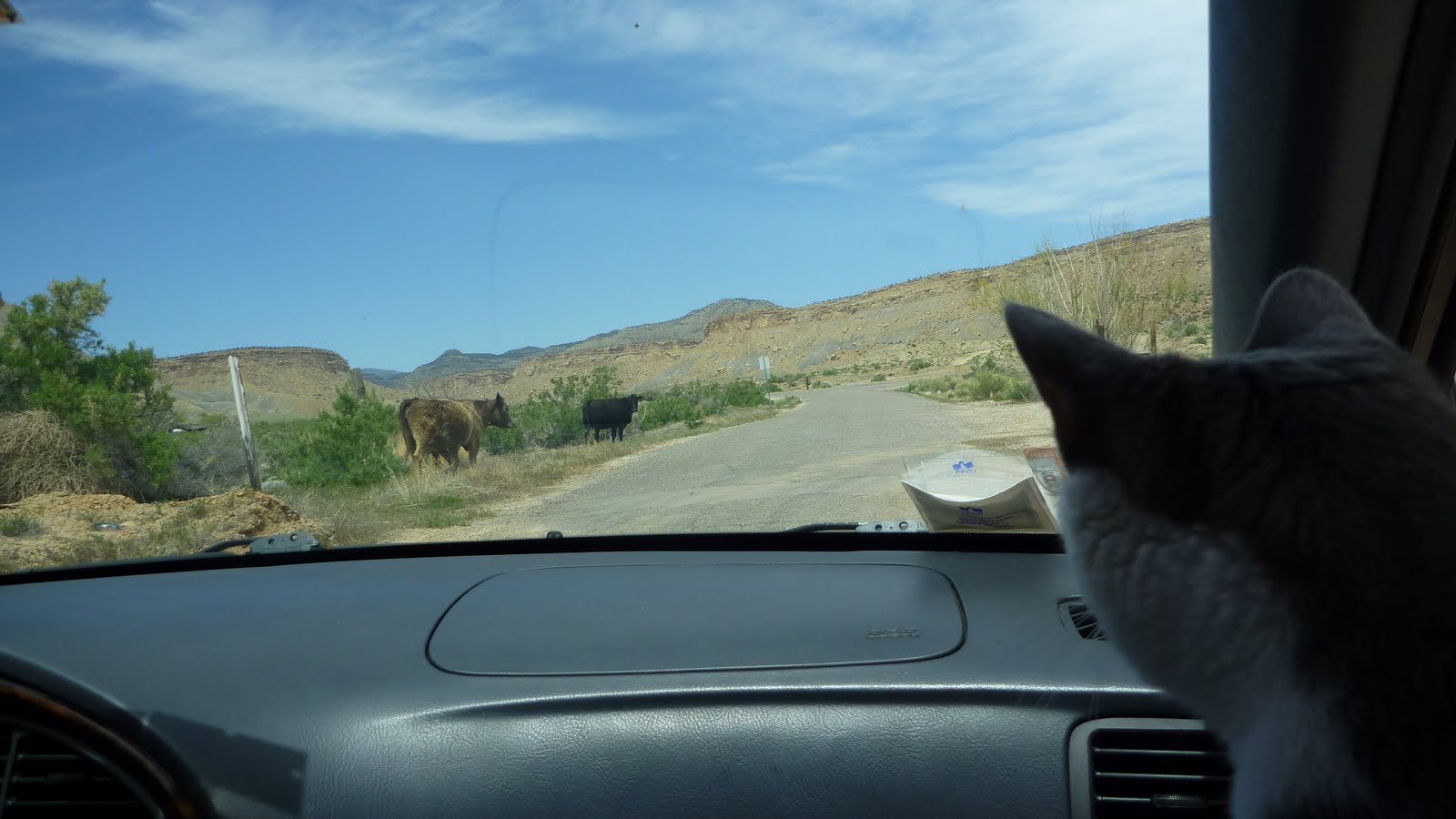
We crossed into Utah fairly quickly. And for awhile it was just the three of us and a long dirt road. That is, until we met some cows grazing along side of the road. We stopped to pee and didn’t even hide behind a bush… there really was no chance of anyone coming across us. The dirt route 6 finally intersected and merged with the far faster moving I-70. And we flew into the canyons of western Utah. The area is quite beautiful, but I certainly can’t see why someone would live here given a choice. That is, it contains some the things I hate the most: blistering hot summers, freezing cold winters, gusty winds, no grocery stores, no cell phone reception, and lots and lots of dust. That and it’s in a conservative state, which coming from Colorado just will not do.
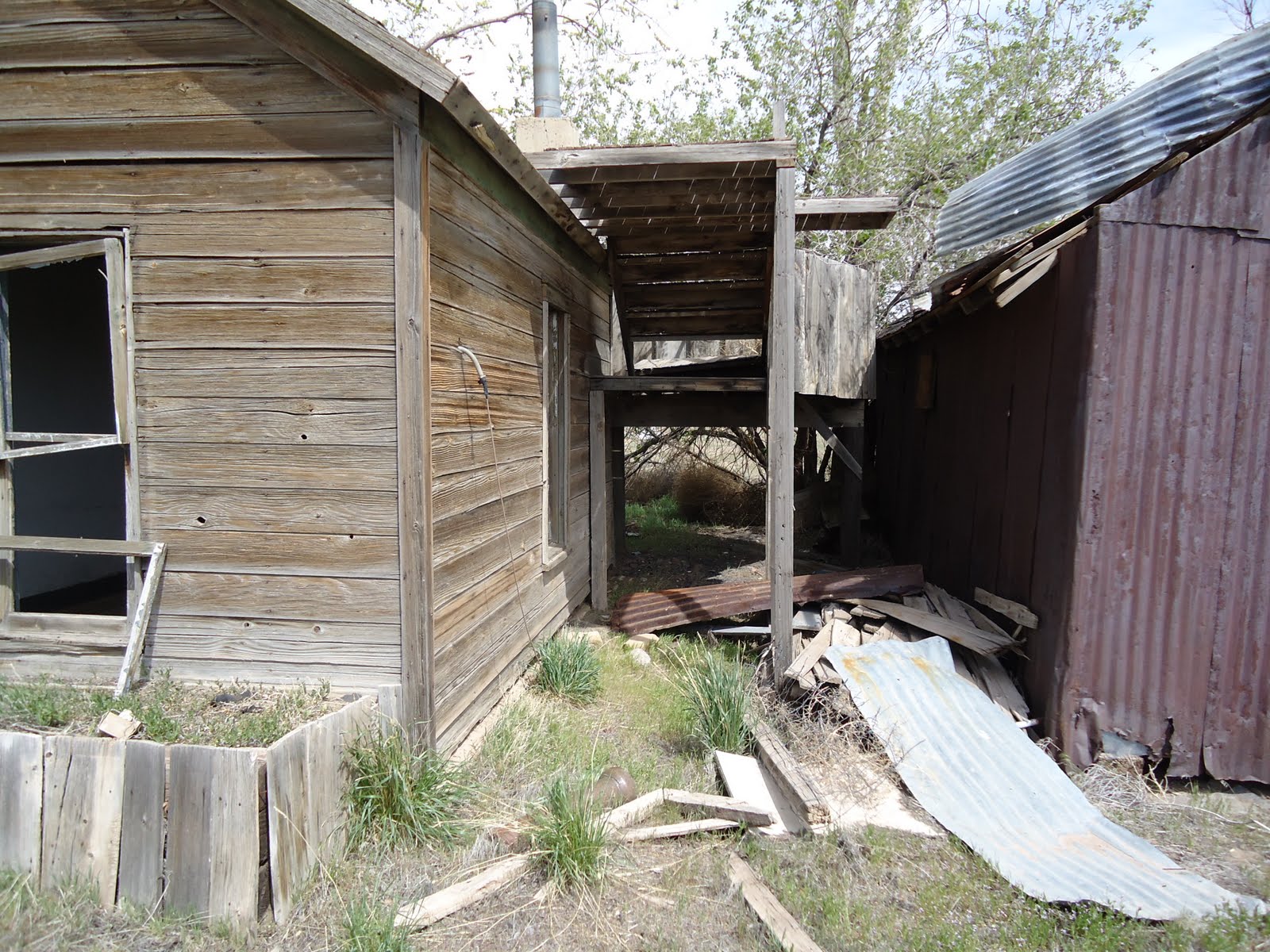
However, everyone we’ve met is friendly thus far, and the cliffs of the area are gorgeous. In the Thompson visitor center parking lot, a man with a cowboy hat and a pickup truck gave us some directions to a “20 minute excursion with a whole lot of diversion.” And boy was he right! Less than 20 mins off the road, through a ghost town and back into the cliffside we saw indian drawings and beautiful rocks. The brush which was in full bloom with yellow flowers scented the air with honey smells. But, just in case, I kept the knife in my pocket. I’ve seen those horror movies… far too many to admit. Here are some pictures of the ghost town (I'll do a separate entry on the indian paintings):
The town began when E.W. Thompson, who lived near the springs,
 operated a sawmill to the north, near the Book Cliffs. Soon a small community grew up called Thompson Springs, made up of small-scale farmers, sheepherders and cattlemen.
However, there was one ambitious man in the area named Harry Ballard, an Englishman, who had plans of grandeur. A successful sheep and cattleman, Ballard began to buy up much of the property that surrounded Thompson Springs, and before long, owned a hotel, store, saloon, a several homes in the small settlement.
Soon, the little community was large enough to convince the Denver and Rio Grande Western
 Railroad, which had been completed through the region in 1883, to add a stop in the settlement, Cattle and sheep men welcomed the railroad, which soon became a small shipping point for their stock.
A post office was established in 1890 and called "Thompson’s” after the original owner, E.W. Thompson. Sometime later, ambitious Harry Ballard discovered a large vein of coal on land adjacent to his ranch about five miles north of Thompsons. Keeping his discovery quiet, he soon bought the surrounding property and started coal operations on a small scale. However, Ballard sold his operation to Salt Lake City investors in 1911, and the coal mining
 town of Sego was born, bringing more prosperity to the area.
To read the rest of this article on Thompson Springs, please visit this link: http://www.legendsofamerica.com/ut-thompson.html
By four o’clock I started to get hungry and we settled on Scofield State park for the night. Mateo had a hell of a time setting up the tent. The ground was too rocky to not have a hammer for the tent stakes. I had a hard time cooking dinner because of our shitty little can opener and a general lack of appropriate pots and pans. But, everything worked out. It’s 7:30 p.m. and I’m in the tent with a full belly.
The wildlife of Utah so far includes many cows, some deer, very few horse farms, a bird whose call sounds like squirting water, and little ground rodents that look like mini gophers and make bird noises.
Subscribe to:
Posts (Atom)

